Author: Trang Dinh Thu

What Are N+1 and 2N? Which Redundancy Level Should You Choose for a Data Center?

When IT systems go down, everything stops: transactions, operations, customer access to your services. So when choosing where to host your infrastructure, the key question is not only “where is this Data Center?” but also “what happens if a single component, or an entire system, fails?” The answer lies in the redundancy level of the power and cooling infrastructure, usually described with two terms: N+1 and 2N.

What does “N” mean?

N is the minimum number of units needed to run the full load. For example, if a cooling system needs 4 units running at the same time to serve the entire server room, then N = 4. Every redundancy model starts from this number.
N+1: component-level redundancy

N+1 means that on top of the N units required to operate, the system has 1 additional spare unit. If a unit fails or needs maintenance, the spare takes over so the system keeps its full capacity.
  • Protection at the unit level: one failed unit does not interrupt service.
  • Investment and operating costs are lower than duplicating the entire system.
  • Units usually still share the same feed path, so a single point of failure can remain in the power feed or in a shared path.
N+1 is a sound choice for most businesses, especially when the system can tolerate a small level of risk and the budget needs to stay balanced.

2N: full system redundancy

2N means two completely independent systems, each able to carry 100% of the load. The two systems have separate feed paths and separate equipment. The customer’s equipment uses two power cords (dual-corded), each connected to a different system.
  • If one entire system stops working, the other keeps running normally.
  • There is no single point of failure between the two feed paths.
  • Well suited to systems that cannot tolerate interruption, such as banking, finance and payments.
  • Higher investment cost, since the infrastructure is built and operated twice.

N+1 vs 2N at a glance

Criteria N+1 2N
How redundancy works 1 additional spare unit Entire system duplicated
Level of protection Unit level System level
Single point of failure Remains in the shared feed path None between the two feed paths
Cost Optimized Higher
Best for Most businesses Mission-critical systems that cannot tolerate interruption

Which model should your business choose?

There is no single right answer. Three questions help you decide:
  1. How much does every hour of downtime cost? Include revenue, recovery costs, and the impact on reputation and customers.
  2. Which systems are your core systems? Transaction, payment or customer-data applications usually need a higher redundancy level than internal systems or test environments.
  3. Does your industry have specific requirements? Some sectors, such as finance and banking, have high continuity requirements. Check the regulations and the requirements of your regulator or partners.
In practice, many businesses combine both: core systems in a 2N environment, other systems in an N+1 environment to optimize cost.

What to ask your Data Center provider

A redundancy level only means something when it is stated clearly. When comparing providers, ask:
  • Which parts of the infrastructure does N+1 or 2N apply to: power, UPS, generators, cooling, or everything?
  • Are the two power feeds truly independent of each other?
  • Does the facility offer multi-carrier connectivity, to avoid depending on a single network path?
  • Is there a 24/7 operations team with a clear incident-handling process?
  • Is your equipment dual-corded, so that it can take advantage of a 2N model?

What options does Telehouse Vietnam offer?

The Standard 42U package from Telehouse Vietnam comes in two options, depending on the redundancy level your business needs:
Item N+1 option 2N power option
Power N+1 redundant UPS 2N, two independent power feeds (dual power feeds)
Cooling N+1 redundant air conditioning N+1 redundancy
Temperature 20°C – 24°C 20°C – 24°C
Humidity 40% – 55% 40% – 55%
Fire protection VESDA, FM200 VESDA, FM200
Monitoring CCTV, 24/7 operation CCTV, 24/7 operation
In the 2N option, power is duplicated while cooling still follows the N+1 model. The 2N package also offers expandable capacity. Businesses can choose the right package for each system instead of using one solution for everything.

Conclusion

N+1 and 2N are not “good” and “bad”. They are two investment levels for two levels of risk. The most effective approach is to start with one question: which of your systems cannot stop, and how long can the business tolerate it being down? Considering infrastructure options for your systems? Contact the Telehouse Vietnam team for advice on the right option.

What Is DC-DR? Why Financial Institutions Cannot Afford to Overlook Disaster Recovery

When a primary system goes down — whether from a power outage, natural disaster or cyberattack — the question is never “will we be affected?” but “how long will it take to recover?” DC-DR is the answer to that question.


What Is DC-DR?

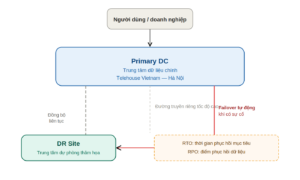
DC-DR stands for Data Center – Disaster Recovery: a model that pairs a primary data center (Primary DC) with a dedicated disaster recovery site (DR Site). When the primary DC experiences a serious failure, operations are switched — automatically or manually — to the DR Site, ensuring services are not completely interrupted.

The Two Most Important Metrics in DC-DR

When designing a DC-DR solution, there are two key technical indicators every organization must understand:

  • RTO (Recovery Time Objective) — the maximum acceptable time from the moment of failure to the moment systems are back online. For banks, RTO requirements typically range from a few minutes to a few hours.
  • RPO (Recovery Point Objective) — the maximum amount of data loss an organization can tolerate, measured in time. The lower the RPO, the more frequently data must be synchronized between sites.

These two metrics drive every architectural decision and cost consideration in a DR solution.

Why It Matters Most for Financial Institutions

The State Bank of Vietnam and financial regulators require institutions in the sector to maintain clear, regularly tested disaster recovery plans. Even a few hours of banking system downtime can trigger serious consequences — direct financial losses, erosion of customer trust and regulatory exposure.

Operating without a DR Site means the entire business depends on the continued availability of a single location. That is not a risk strategy — it is the absence of one.

DC-DR Solutions at Telehouse Vietnam

Telehouse Vietnam provides DC-DR solutions built on a broad partner ecosystem — supporting businesses in establishing geographically independent DR Sites with dedicated high-speed connectivity to their primary DC. This model ensures continuous data synchronization and rapid failover when it is needed most.

With extensive experience serving financial institutions and banks with demanding RTO and RPO requirements, Telehouse Vietnam is ready to consult and design a DC-DR solution tailored to your scale and budget.

📞 024 3795 0791 | 📧 contact.tiv@telehouse.vn | 🌐 www.telehouse.vn

Why Should Businesses Choose a Data Center Instead of the Cloud?

“Just move to the cloud and you’re done” — many businesses believe this, until the monthly bill keeps climbing and critical data ends up somewhere they don’t fully control. So when does a Data Center (colocation) actually make more sense?

1. Long-term cost Cloud is cheap at first because you pay as you go, but for stable workloads, colocation at a Data Center is often more cost-effective over time — which is why many businesses eventually move part of their infrastructure back to a physical DC.

2. Data control With international cloud providers, businesses depend on a third party’s policies and server locations. With a domestic Data Center, businesses know exactly where their data resides and can more easily comply with local data storage regulations in Vietnam.

3. Consistent performance Cloud infrastructure is shared, so it can be affected by “noisy neighbors.” Colocation gives full control over configuration, optimized specifically for your workload — critical for low-latency systems or AI/GPU workloads.

4. Compliance & certifications Data Centers certified with ISO 27001, ISO 22301, and ISO 9001 let businesses verify operational processes — something many mainstream cloud services don’t disclose in detail. This matters greatly for finance, insurance, and healthcare industries.

5. It’s not either/or — it’s choosing what fits Many large enterprises use a hybrid model: cloud for applications that need flexible scaling, and Data Center for core systems and sensitive data. The real question isn’t “which is better,” but “which part of my system actually needs the cloud, and which part needs a Data Center.”

In short: Cloud is ideal for fast, flexible deployment. Data Center is ideal when you need cost control, data ownership, and strict compliance. Understanding your real needs is the first step to choosing correctly.

What Is ISO 22301? Is Your IT Infrastructure Truly Ready for a Disaster?

No one wants to think about worst-case scenarios — but the organizations that prepare for them are the ones that survive a crisis. ISO 22301 is the international standard that helps businesses build that capability in a structured, verifiable way.


What Is ISO 22301?

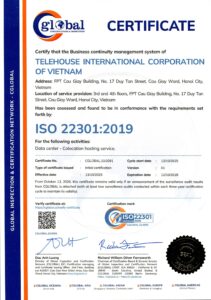
ISO 22301 is the international standard for Business Continuity Management Systems (BCMS), published by the International Organization for Standardization (ISO). The current version — ISO 22301:2019 — is designed to help organizations prepare for, respond to and recover from serious disruptions such as power outages, natural disasters, system failures or cyberattacks.

What Does Certification Require?

To achieve certification, an organization must build and maintain a comprehensive management system that includes:

  • Business Impact Analysis (BIA) to identify critical functions that need priority protection
  • Specific response and recovery plans for each type of disruption scenario
  • Regular drills and exercises to test the effectiveness of those plans
  • Defined Recovery Time Objectives (RTO) and Recovery Point Objectives (RPO)
  • Independent assessment by an accredited third-party certification body

Why Does It Matter for Financial Institutions?

For banks and financial organizations, even a few minutes of system downtime can cause significant damage — from direct financial losses to reputational harm with customers and regulators. The State Bank of Vietnam and many international bodies require institutions in the sector to maintain clear and tested business continuity plans.

Placing systems in an ISO 22301-certified data center means more than renting rack space — it means operating within an environment that has been independently verified for its ability to maintain continuity under any circumstance.

Telehouse Vietnam and ISO 22301:2019

Telehouse Vietnam maintains ISO 22301:2019 certification as a commitment to every customer that — whatever happens, your systems will be protected and recovered according to a tested, verified plan. Combined with 2N redundant power infrastructure, generator capacity ensuring 72 hours of continuous operation and a 24/7/365 NOC team, ISO 22301 represents the highest level of business continuity assurance Telehouse Vietnam delivers.

📞 024 3795 0791 | 📧 contact.tiv@telehouse.vn | 🌐 www.telehouse.vn

What Is ISO 9001? Why a Quality Management Certification Matters for a Professional Data Center

When evaluating data centers, most people focus on security or power infrastructure — few pay attention to quality management certification. Yet ISO 9001 is the foundation that ensures every operational process is executed correctly, completely and consistently, every single day.


What Is ISO 9001?

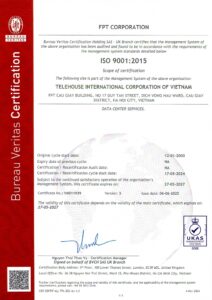
ISO 9001 is the international standard for Quality Management Systems (QMS), published by the International Organization for Standardization (ISO). The current version — ISO 9001:2015 — is applied in over 170 countries and remains one of the most widely recognized management certifications in the world.

What Does Certification Require?

Unlike technical standards, ISO 9001 focuses on how an organization manages and continuously improves its processes. To achieve certification, an organization must:

  • Establish clearly defined, fully documented workflows
  • Systematically measure and monitor service quality
  • Handle incidents and complaints through standardized procedures
  • Conduct regular internal audits and drive continuous improvement
  • Undergo independent assessment by an accredited third-party certification body

What Does This Mean for Data Center Customers?

A data center holding ISO 9001 certification does not just have good infrastructure — it operates with a system. That means when you submit a support request, there is a clear process to handle it. When an incident occurs, there is a standard response procedure. When operational reports are needed, records are properly maintained and readily available.

For financial institutions and banks, this is especially critical when facing internal audits or reporting requirements from regulatory authorities.

Telehouse Vietnam and ISO 9001:2015

Telehouse Vietnam maintains ISO 9001:2015 certification as part of a comprehensive quality management framework — ensuring that every service, from colocation and connectivity to NOC operations, is delivered through standardized, measurable and continuously improving processes.

📞 024 3795 0791 | 📧 contact.tiv@telehouse.vn | 🌐 www.telehouse.vn

  • 1
  • 2